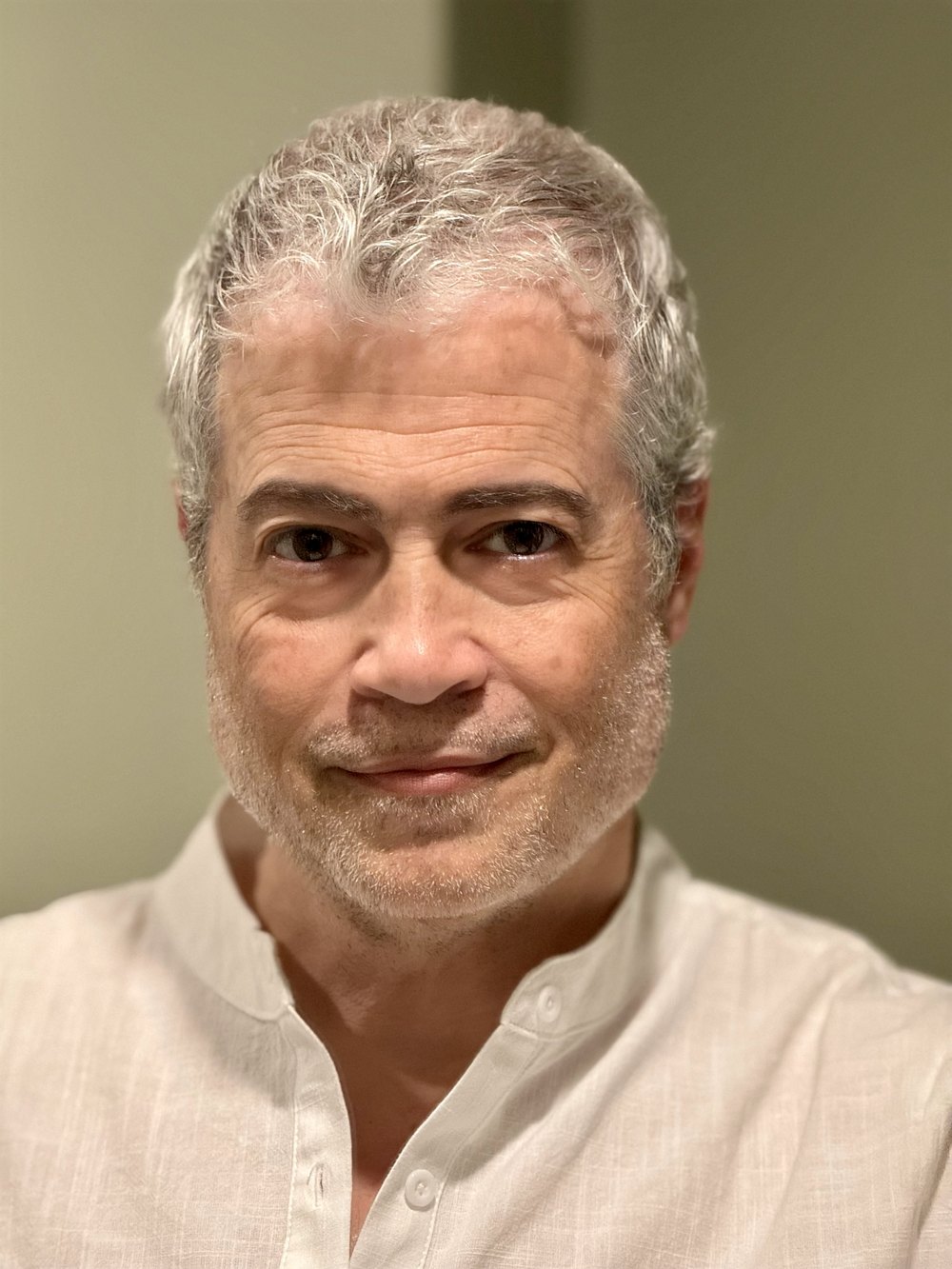
Two minutes, in his own words
Matt recorded this in his office. He talks about the survey he ran in his lecture class, what the answers showed, and what Resonance does about it. It's 2 minutes 21 seconds long. You can turn on captions in the player, and the full transcript, including everything shown on screen, is below.
Matt wrote the longer version of this story on his Substack, Find your people with Resonance.
Read the transcript
0:00 Matt Lieberman, in an office lined with bookshelves. "A couple of years ago I was teaching a large lecture class at UCLA, and I decided to anonymously survey the students. And what I found is that about two thirds of the students said they had struggled with making friends at UCLA and had experienced significant loneliness while they were here."
0:16 On screen: a campus walkway between classes, crowded with students. One of them walks alone, looking down at his phone.
0:19 Back to Matt. "I'm Matt Lieberman, a professor of psychology and neuroscience at UCLA, and for the past 25 years I've been studying what makes us the social creatures that we are."
0:20 On screen, a name super across the lower third: "MATTHEW LIEBERMAN — UCLA SOCIAL NEUROSCIENTIST · FOUNDER, RESONANCE".
0:32 "And for the past few of those years I've been building Resonance, in order to help people find their people." On screen, filling the frame, the Resonance landing page: the wordmark "Resonance" under the ripple mark, then "See how you see the world. Find the people who see it with you.", then "Welcome to the first network that connects you to people based on your actual compatibility." Three buttons follow: "Take the survey — free", "Login / Create your account", and "The Knowing Game (party edition)".
0:39 "And here's how it got started."
0:42 On screen: a lecture hall of red seats, mostly empty. One student sits alone with a notebook while a group of five talks in the row behind her. "In a room full of 300 students, there are definitely people for every single person to really connect with. But most of them will never meet the right person in that classroom, and the same thing holds true at the university in general."
0:51 Back to Matt.
0:58 "It's really a needle in the haystack kind of problem. And so that's what we built Resonance to be — the magnet that can find those needles."
1:09 "Joining Resonance starts with 10 to 12 minutes of answering questions about what you notice and how you see the world. Compatible people tend to see the world in compatible ways." On screen, the survey scrolls through statements 1 to 8 of 8. Each is answered on a one-to-five scale labelled "Strongly disagree" at the left and "Strongly agree" at the right:
- Statement 1 of 8 — "I notice when other people are in need of help and care." (answered 5)
- Statement 2 of 8 — "I notice power dynamics going on in front of me." (answered 2)
- Statement 3 of 8 — "I notice when things could be made more efficient."
- Statement 4 of 8 — "I notice when spaces are clean"
- Statement 5 of 8 — "I see the poetic aspects of things around me" (answered 5)
- Statement 6 of 8 — "I notice whether people are contributing equally or not" (answered 4)
- Statement 7 of 8 — "I see ways to make situations more fun"
- Statement 8 of 8 — "I notice opportunities to create social connection with strangers and acquaintances"
1:22 On screen, a personal report scrolls past. Its headings, in order: "Next steps", "Your profile is the next step", "Invite people you know", "Keep this report", "How to read this report", "Your perceptual type" — whose prose opens "You're a Horizon Seeker, one of the 20% of people whose attention naturally tilts toward what's opening up rather than closing down" — and then "Your dimension profile" beside a radar chart. Over it: "As soon as you finish the survey, you'll get a report about yourself, and people tell us that this report is surprisingly insightful. You could just take the survey in order to get that report. That's fine."
1:36 "But after you get the report, we'll hand you two or three matches that our algorithm says you are incredibly likely to connect with, and we'll help you break the ice. And once you connect with them, we'll give you some more. There's no feed, there's no endless scrolling." On screen, a matches page headed "UCLA · INCOMING FIRST YEARS", then "Your matches", then "Two people we think you'll really connect with". Two cards follow, each with a "Connect" button: "Priya R., second year, Cognitive Science, 96% compatible — You both notice unspoken care in a room. She reads systems where you read stories — that difference is why this works." and "Daniel K., first year, Undeclared, 94% compatible — Shares your eye for beauty in the ordinary. Notices risk far more than you do."
1:48 Back to Matt.
1:55 "And there are various ways to connect inside the Resonance app. I recommend playing one of our quick games with the new people that you match with."
2:00 On screen, a game in progress: "WINNER STAYS", "ROUND 3 OF 10", "Best live show you'd actually pay for". Two answer cards face each other across a "VS" — "Sabrina Carpenter — CHAMPION, 2 WINS", marked "STAYS", and "Tyler, the Creator — CHALLENGER". Underneath: "Priya is picking too — you'll both see the results".
2:04 Back to Matt. "And if you leave the app because you've made some really great friends through Resonance, well… that's good too, because that's the whole point of what we're trying to do. It's completely free. So go to resonance.info and come find your friends."
2:14 On screen, the end card: the Resonance ripple mark above a widening ripple, the wordmark "Resonance", the line "Come find your friends", and the address "resonance.info". Nothing is spoken over it.